Countertops are the surface you touch every day, and the material you pick decides how much you think about them afterward. Below are the main types of countertops, what each one is good and bad at, and how each handles a Las Vegas kitchen with hard water, strong sun, and dry heat.
The Short Answer
Most remodeled kitchens use one of four materials: quartz for low maintenance, granite for natural stone that forgives abuse, quartzite for the look of marble with far more durability, or porcelain for heat and sun resistance in a thin, modern slab. Marble, solid surface, butcher block, laminate, and concrete fill specific roles: a baking station, a budget refresh, a warm accent on an island.
| Material | What it is | Heat | Stains | Sealing | Best for |
|---|---|---|---|---|---|
| Quartz | Engineered quartz and resin | Fair | Excellent | Never | Busy family kitchens |
| Granite | Natural igneous stone | Excellent | Good once sealed | Every 1-2 years | All-around durability |
| Quartzite | Natural metamorphic stone | Excellent | Good once sealed | Periodically | Marble look, real toughness |
| Marble | Natural calcite stone | Good | Poor (etches) | Regularly | Baking areas, low-traffic islands |
| Porcelain | Fired ceramic slab | Excellent | Excellent | Never | Sunny kitchens, outdoor kitchens |
| Solid surface | Acrylic or polyester resin | Poor | Good | Never | Seamless integrated sinks |
| Butcher block | Glued hardwood | Poor | Fair | Oiling | Island accents, prep zones |
| Laminate | Printed layer on particleboard | Poor | Good | Never | Budget refreshes, rentals |
| Concrete | Cast cement | Good | Fair | Regularly | Industrial or custom designs |
The heat and stain ratings are general comparisons. Individual products vary, so read the manufacturer’s care guide for the exact slab you choose.
Engineered Surfaces
Quartz
Quartz countertops are made from roughly 90 percent ground quartz bound with resin and pigment. Because the resin fills every pore, quartz never needs sealing and shrugs off coffee, wine, and oil. It comes in consistent colors and patterns, including marble-look designs with soft veining, so what you see in the showroom is what arrives.
The trade-off is heat and sunlight. The resin can scorch under a hot pan, so trivets are part of owning quartz. Long exposure to direct UV can also yellow or fade some colors, which is why most quartz manufacturers exclude outdoor use from their warranties. In a Las Vegas kitchen with a big west-facing window, that is worth thinking about before you choose a pure white.
Porcelain (sintered stone)
Porcelain slabs are fired at very high temperatures, which makes them dense, non-porous, heat-resistant, and stable in sunlight. They come in thin profiles that suit modern kitchens and can run up a backsplash or across an island waterfall. Porcelain is one of the few surfaces that works equally well indoors and in an outdoor kitchen.
Porcelain is harder to fabricate than quartz, and edges and corners can chip if they take a sharp hit, so the fabricator’s experience matters. If you are weighing it against quartz, our quartz vs porcelain comparison goes into detail.
Solid surface
Solid surface (acrylic or polyester resin) is seamless, repairable, and allows integrated sinks with no visible joint. It scratches and scorches more easily than stone, so it shows up more in bathrooms and lower-traffic spaces than in hard-working kitchens today.
Natural Stone
Granite
Granite is an igneous stone and one of the most forgiving countertops you can buy. It handles hot pans, resists scratches, and hides crumbs and wear thanks to its speckled pattern. Each slab is unique, which is part of the appeal, so plan to see your actual slabs at the yard before fabrication. Granite needs sealing periodically, and a simple water-drop test tells you when.
Quartzite
Quartzite is sandstone transformed by heat and pressure into a very hard, crystalline stone. It often has the white or grey veining people love in marble, with much better resistance to heat and scratches. It still needs sealing, and some stones sold as “soft quartzite” behave more like marble, so ask your fabricator to test a sample with lemon juice before you commit.
Marble
Marble is beautiful, cool to the touch, and the classic surface for rolling dough. It is also calcite, which means acids etch it. Lemon juice, vinegar, tomato sauce, and many hard-water cleaners leave dull marks. Homeowners who love marble often use it on a baking station or a secondary island and choose something tougher for the main prep area.
Wood, Laminate, and Concrete
Butcher block adds warmth, is gentle on knives, and pairs well with stone on an island end or a prep zone. It needs regular oiling and does not love standing water at the sink.
Laminate has improved a lot, with realistic stone and wood prints. It is the most affordable option, but it cannot take heat, and chips or burns are hard to repair.
Concrete can be cast in custom shapes and colors. It needs sealing, can develop hairline cracks, and is a specialty product best suited to a specific design vision.
What Desert Living Changes
Three Las Vegas conditions shape the choice more than they would elsewhere:
- Hard water. Mineral spots build up fast around faucets. Non-porous surfaces wipe clean easily. Marble and limestone can etch from the acidic cleaners people use on hard-water deposits.
- Sun through big windows. Many valley homes have large glass walls and sliders. Natural stone and porcelain hold their color in direct sun. Some quartz colors can shift over years of strong UV.
- Outdoor kitchens. Patio kitchens see triple-digit heat and full sun. Granite, porcelain, and quartzite are the dependable options there.
Choosing Countertops for a Summerlin Kitchen
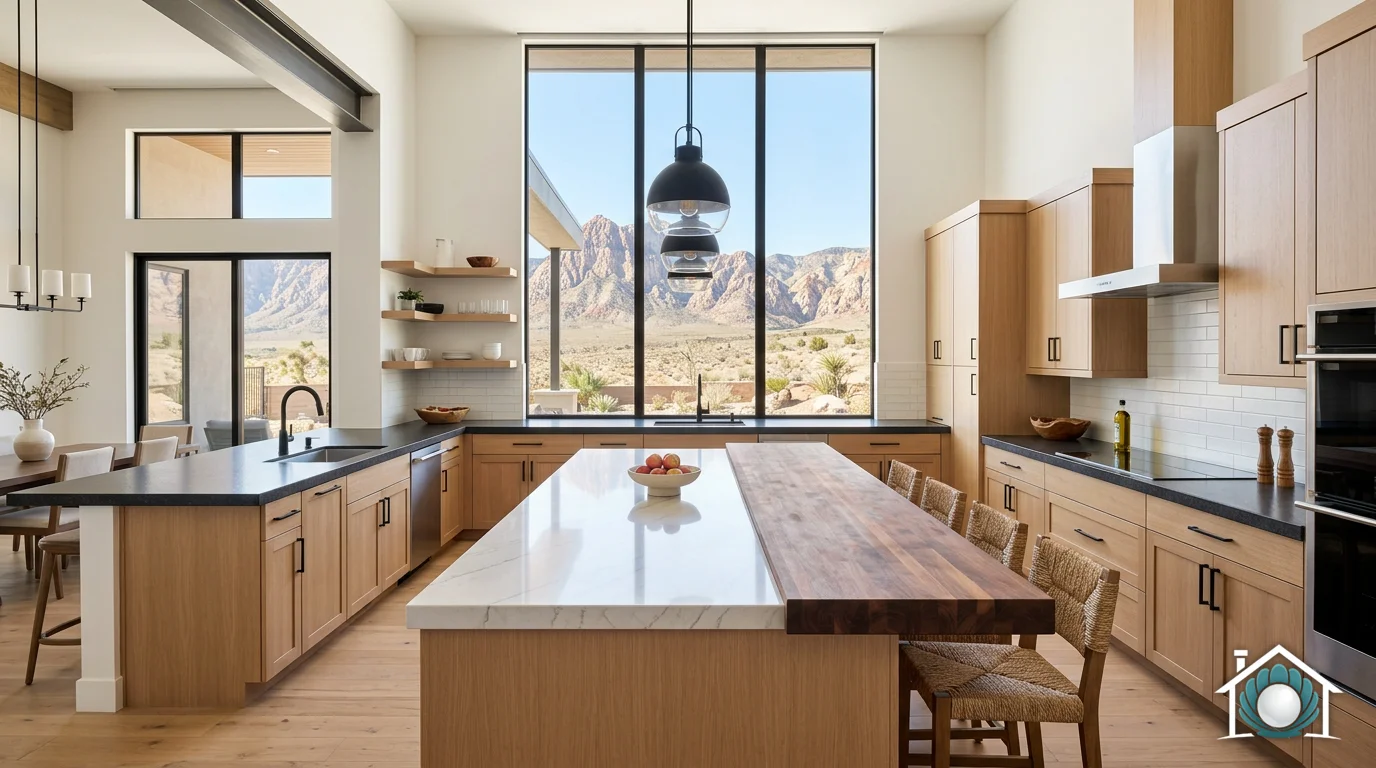
Summerlin kitchens tend to be large and open to a great room, often with long islands and walls of west-facing glass looking toward the Spring Mountains. That combination favors two strategies. Many homeowners pair a durable perimeter (granite or quartz) with a showpiece island in quartzite or a marble-look porcelain. Others use one material throughout for a clean, continuous look.
If your island takes afternoon sun, put a sample on that spot for a few days and see how it reads at different times. Light here is strong enough to change how a white or cream slab looks. If you are planning a kitchen remodel in Summerlin, slab selection usually happens early in design, because the countertop drives the backsplash, the cabinet color, and the sink choice.
Picking the Right Surface
Start with how you cook. If you put hot pans down without thinking, lean toward granite, quartzite, or porcelain. If you want zero maintenance and consistent color, quartz is hard to beat. If you love the look of marble but not the upkeep, look at quartzite or a marble-look porcelain.
Countertops are one part of a kitchen remodel where seeing real slabs in person matters. Pearl walks clients through material samples in their own kitchen light and coordinates templating and fabrication so the counters fit the first time. Request a free in-home consultation or call (702) 602-8385 to start planning.