The pergola vs patio cover question is one of the most common decisions in any North Las Vegas backyard remodel. Both structures define an outdoor living area, both add architectural weight to a yard that was previously just open ground, and both get pitched in basically every contractor’s marketing photos. They are not the same product, though, and the wrong choice for your specific yard and use case becomes obvious within the first summer.
The honest answer is that neither one is universally better. Pergolas and patio covers solve different problems, and the right pick depends on how you plan to use the space, when you plan to use it, and how much you are willing to spend on long-term shade. Here is a clear comparison for North Las Vegas homeowners, including what each structure actually does, what it costs, and which one fits which yard.
What a Pergola Actually Does
A pergola is a structure with vertical posts supporting an overhead grid of beams and slats. The defining trait is that the overhead is open or partially open to the sky. A traditional wood pergola has slats spaced an inch or two apart that cast a striped shadow on the patio below. A modern aluminum louvered pergola has adjustable vanes that can rotate from fully open to fully closed.
What a pergola is good at: defining a space, framing a view, supporting climbing plants (where the climate and irrigation cooperate), creating a sense of “outdoor room” without enclosing the patio, and providing a structural element that can hold string lights, ceiling fans, or shade fabric. In milder climates a pergola is often enough on its own. In North Las Vegas in July at 2 PM, it is not.
What a pergola is not good at: blocking direct overhead sun during peak summer hours. A standard slatted pergola provides somewhere around 30 to 60 percent shade depending on the slat spacing, sun angle, and orientation. That can feel pleasant in spring and fall, and tolerable in summer mornings and evenings. From mid-morning through late afternoon in June, July, and August, an unmodified pergola is not enough.
The fix that most North Las Vegas pergola installs use is a secondary shade layer: shade-cloth panels stretched across the top of the slats, polycarbonate roof panels installed above the slats, or a retractable canopy that slides across the underside. With one of these additions, a pergola can deliver 80 to 95 percent shade and become genuinely usable in summer. The cost of the addition is significant - sometimes [$1,000 - $4,000] depending on the system - and the look changes from “open pergola” to “pergola with a shade hat.”
The most flexible (and most expensive) version is a motorized louvered pergola with vanes that close to form a solid roof. Open for shoulder seasons, closed for peak summer afternoons. These are excellent products and have become more common in higher-end North Las Vegas backyards, but the price tag is closer to a premium patio cover than a basic pergola.
What a Patio Cover Actually Does
A patio cover is a structure with a solid roof. The most common materials in this market are insulated aluminum panels (factory-finished, lightweight, fast to install), wood-framed with a roof deck and tile or shingle matched to the house, and custom stucco-finished structures built to look like an extension of the home itself.
A solid patio cover does the one thing a pergola cannot: it stops direct overhead sun completely. The patio under a properly built patio cover stays in shade all day, regardless of season. Surface temperatures on the patio floor drop by 20 to 40 degrees compared to an uncovered patio in the same yard. The covered space becomes a real outdoor room rather than a sunlit corner.
The functional advantages compound. A solid cover accepts ceiling fans (rated for outdoor use), recessed lighting, outdoor speakers, an outlet for a mounted TV, and weatherproof electrical that turns the patio into a usable evening space. It blocks the occasional monsoon rain so outdoor furniture and electronics survive. It protects the patio surface itself from sun damage, which extends the life of pavers, stained concrete, and tile.
The trade-off is visual weight and openness. A solid cover makes the patio feel more enclosed and shadier in shoulder seasons - which most homeowners find appealing in July but slightly heavy-feeling in April. Insulated aluminum covers are the lightest visually; stucco-finished covers are the most architectural but read most solid.
Side-by-Side
| Attribute | Pergola (standard slatted) | Pergola (motorized louvered) | Solid Patio Cover |
|---|---|---|---|
| Shade in July at 2 PM | 30 - 60% | 95%+ when closed | 100% |
| Spring / fall feel | Open and bright | Adjustable, ideal | Slightly shadier |
| Cost installed (12x14 ft) | [$4,000 - $9,000] wood, more for aluminum | [$15,000 - $35,000] | [$6,000 - $14,000] aluminum, [$18,000 - $40,000] stucco |
| Supports ceiling fan + lights | Only with integrated beam | Yes | Yes |
| Rain protection | None | Yes when closed | Yes |
| Lifespan | 12 - 18 years (wood), 25 - 40 (aluminum) | 25 - 40 years | 25 - 40 years |
| Maintenance | Wood: refinish every 2 - 4 years. Aluminum: rinse occasionally | Periodic motor and seal service | Minimal - rinse occasionally |
| Visual feel | Open, architectural, garden-style | Architectural, adaptable | More enclosed, room-like |
| HOA acceptance | Generally easy | Generally easy | Generally easy with material approval |
| Resale impact | Modest positive | Strong positive | Strong positive, especially with electrical |
The motorized louvered pergola tops the chart on flexibility and largely dissolves the original pergola-vs-cover question - it is both, depending on the position of the vanes. The cost reflects that. For most North Las Vegas backyards working with a typical remodel budget, the practical decision is between a basic pergola (with or without shade panels) and a solid aluminum patio cover.
When a Pergola Is the Right Choice
A traditional pergola is the right pick when the patio is primarily used during mornings, evenings, and shoulder seasons; when the homeowner wants to keep the backyard feeling open and connected to the sky; when the patio is small enough that a solid cover would make it feel cramped; when garden style or a more traditional aesthetic is the goal; or when a structure is desired to support seasonal shade sails or string lights and the homeowner accepts that mid-day summer use will be limited.
A motorized louvered pergola is the right pick when the budget supports it, when both open and fully-shaded modes are desired, and when the architectural style of the home favors a contemporary look. It is also a strong pick for homeowners who want a single structure to handle full-year use without seasonal modifications.
When a Patio Cover Is the Right Choice
A solid patio cover is the right pick when the patio is intended for genuine all-day, all-season use; when the household entertains in summer and needs reliable shade; when the patio includes electrical features (ceiling fans, lights, TV, outlets); when the budget for shoulder-season shade modifications would otherwise come on top of a basic pergola; or when the patio surface or furniture would benefit from protection from sun and occasional rain.
It is also usually the right pick when the patio is on a west or southwest exposure. Those orientations get the worst summer sun loading, and a pergola without shade modifications will simply not perform on a July afternoon.
The Hybrid Layout
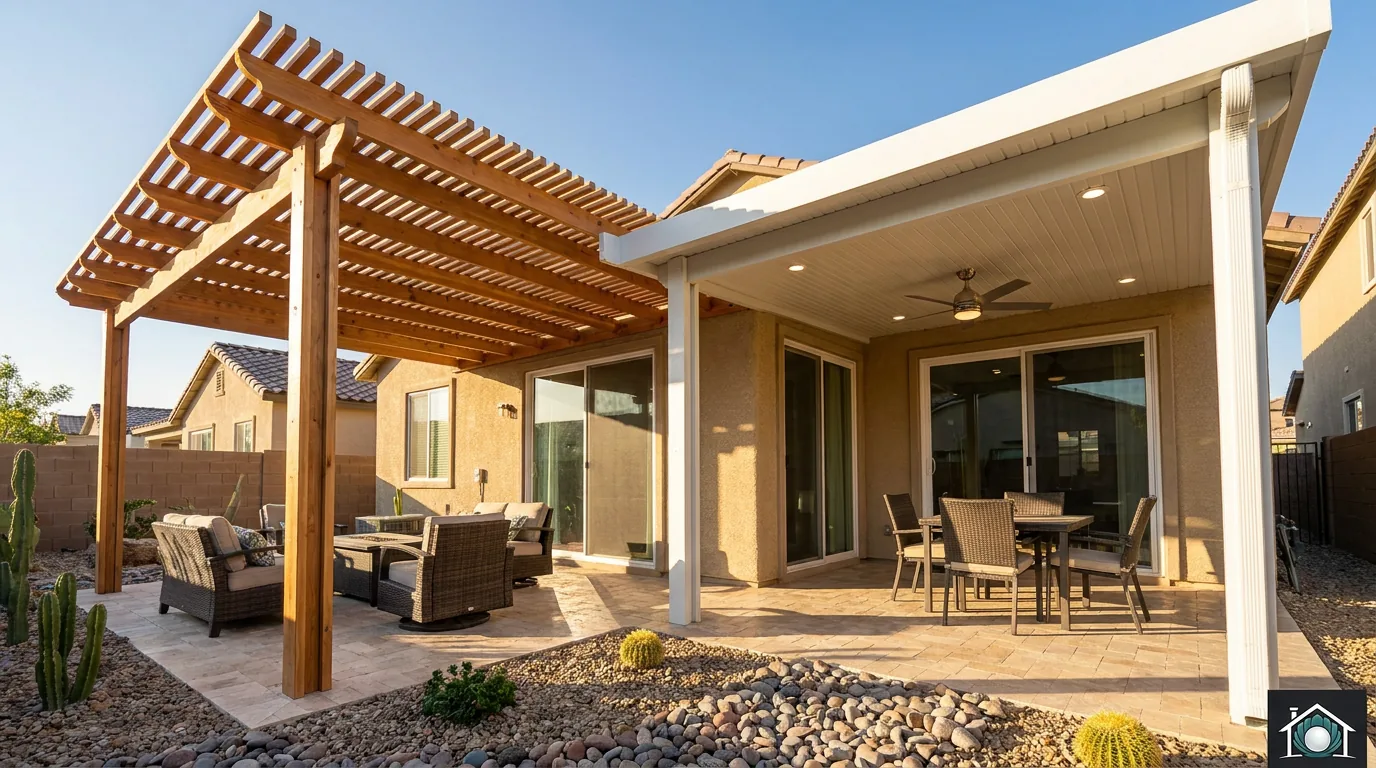
A pattern that has become common in larger North Las Vegas backyards is to combine both structures: a solid patio cover over the main seating and dining area (the workhorse zone that needs to function in summer), with a pergola extending off one edge to define a secondary zone like a fire pit area, a garden seating spot, or a sun-tolerant breakfast nook. The two structures together cost more than either alone, but they give the yard genuine architectural complexity and a usable variety of outdoor zones.
This hybrid approach also works well visually. A pure solid cover spanning the entire back of the home can feel monolithic. Stepping it down to a pergola at the edge softens the silhouette and signals the transition from “outdoor room” to “garden.”
North Las Vegas Specific Considerations
Three factors specific to North Las Vegas backyards matter when choosing between these structures:
Wind exposure. North Las Vegas has stronger and more frequent wind gusts than the southern and western parts of the valley, particularly in spring and fall. Loose shade fabric on a pergola can become a sail in a 40 mph gust. Choose a shade system rated for the wind loads, or favor a solid cover that does not have a fabric component.
Newer construction with tight lot lines. Many North Las Vegas neighborhoods built in the 2010s and 2020s have small backyards and tight side setbacks. A solid patio cover spanning most of the backyard can dramatically reduce natural light entering the back of the house through patio doors. Glass panel inserts in the cover, skylights, or a partially open pergola section near the home can preserve interior daylight while still providing patio shade.
HOA aesthetics. Many of the master-planned communities in North Las Vegas require structures to match the home’s exterior color, finish, and architectural style. Insulated aluminum covers can be color-matched to the stucco. Wood pergolas may need to be a specific stain. Submit the proposal with samples and a rendering before the build - HOA review for either structure typically adds 2 to 6 weeks.
What the Project Looks Like End to End
A straightforward attached patio cover install (insulated aluminum, attached to the home, with electrical and lights but no significant footing work) typically takes 1 to 3 weeks of active construction once permits and HOA approval are in hand. A custom stucco-finished cover that ties into the home’s roofline and matches the exterior architecture usually runs 4 to 8 weeks because of framing, stucco curing, and tie-in trades.
A wood pergola install runs 1 to 3 weeks. A motorized louvered pergola install is typically 1 to 2 weeks of active work but with longer material lead times - many of the premium systems take 4 to 10 weeks from order to delivery. Permitting and HOA approval add 2 to 8 weeks on the front end regardless of structure type.
The right window to start a structure intended to be enjoyed through this summer is early spring - by mid-March at the latest. Reading this in late spring, a solid cover or basic pergola is still very achievable for August enjoyment if design and permitting start immediately.
Pearl handles design, permitting, and full build-out for outdoor living projects across North Las Vegas and the rest of the valley, including pergolas, patio covers, and hybrid layouts. If you are weighing options for your specific yard, request a free in-home consultation or call (702) 602-8385. We will look at sun exposure, intended use, HOA constraints, and the existing yard conditions, and put together a realistic plan and quote.