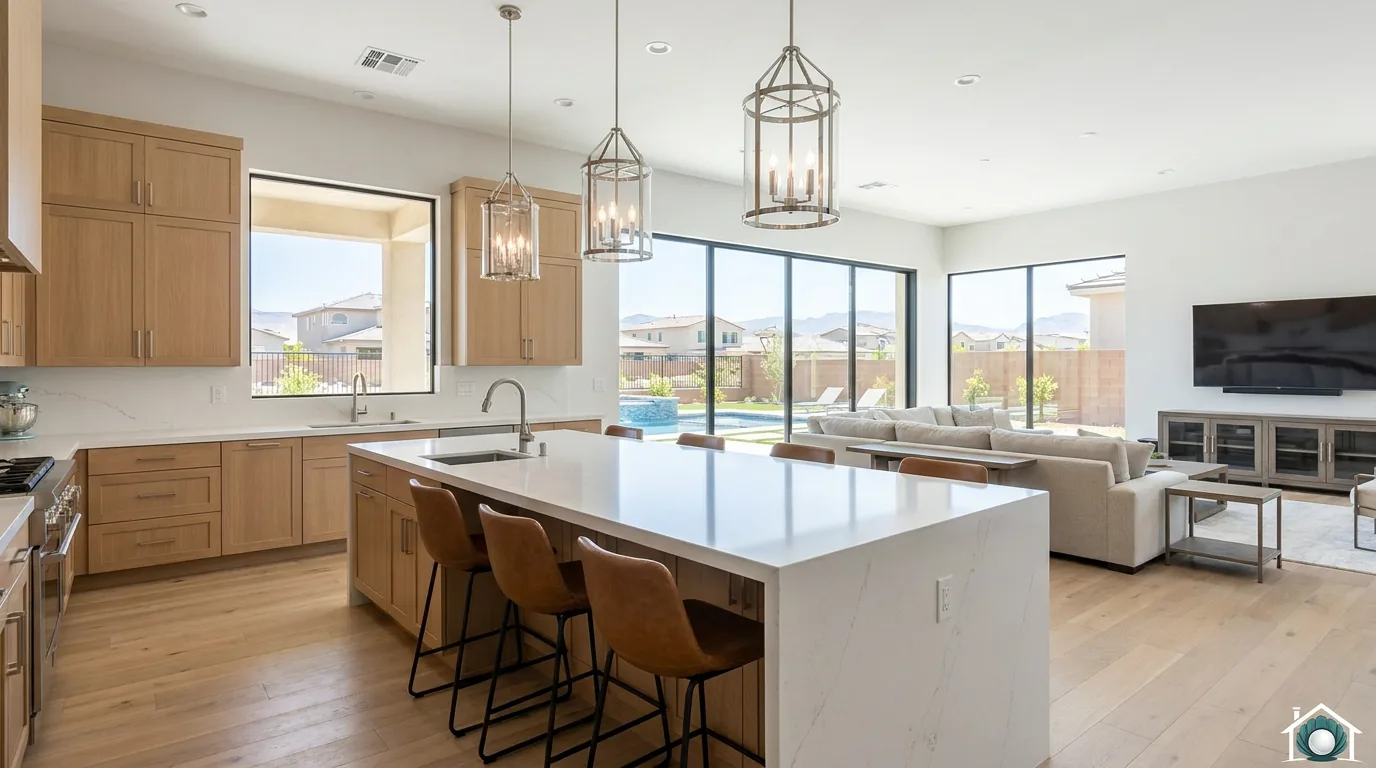
Las Vegas open-concept floor plans put the kitchen in plain view from the living room, the dining area, and often the patio. There is no door to close, no wall to hide behind, and no escape from a layout that does not work. Anything that looks bad or functions poorly is on display every day.
That makes layout the highest-leverage choice in any open-concept kitchen remodel. Cabinets, countertops, and finishes all matter, but the layout decides whether the kitchen is a pleasant place to cook and a beautiful focal point - or a daily source of friction. Here is how to think about kitchen layout in Las Vegas open-concept homes, and what works for the way these homes are actually used.
The Five Layouts You Will Actually Consider
Most open-concept Las Vegas kitchens land in one of these five configurations:
| Layout | Best for | Trade-offs |
|---|---|---|
| L-shape with island | Most open-concept Vegas homes | Versatile, great work flow, defined zones. Needs at least 12 by 14 feet of floor space. |
| U-shape with peninsula | Slightly smaller open spaces | Strong storage and counter area. Peninsula creates a partial barrier - good or bad depending on the room. |
| Single-wall with island | Long narrow open spaces | Clean modern look, minimalist. Limited continuous counter on the wall side - relies heavily on the island. |
| Galley with island | Larger floor plates | Maximum counter and storage. Requires real width or the kitchen feels tight even when open. |
| G-shape | Larger custom homes | Maximum surface and storage, partial enclosure. Can feel closed off if the legs of the G are too long. |
The L-shape with an island is by far the most common in Las Vegas remodels because most homes have the floor plate to support it and it gives the best balance of work flow and openness. The other layouts are right when the geometry of the room genuinely calls for them.
Work Triangle vs Zones
The classic work triangle - sink, range, refrigerator within a roughly equilateral triangle of 12 to 26 feet of total perimeter - still matters, but it is no longer the only framework. Modern kitchen design, especially in homes where two people cook or where the kitchen also handles entertaining, uses zones:
- Prep zone: counter space next to the sink, with knife storage, cutting boards, and trash pull-out within reach.
- Cook zone: counter on either side of the range, with cooking utensils, oils, and spices nearby. Range hood directly above.
- Cleanup zone: sink, dishwasher, trash, and recycling. Glasses and dishes stored within one step.
- Storage zone: pantry, refrigerator, and dry-goods cabinetry, ideally near the entry to the kitchen.
- Serving / casual zone: the side of the island that faces the living room - bar seating, drink cabinet, sometimes a beverage refrigerator.
Designing in zones rather than chasing a perfect triangle gives you flexibility. Two cooks can work in different zones without tripping over each other. Guests can grab a drink at the serving zone without stepping into the prep zone. In an open-concept room where you cannot close a door, that separation is the difference between a kitchen that handles real life and one that only photographs well.
The Island as the Anchor
In an open-concept Las Vegas kitchen, the island is doing four jobs at once: it is the prep counter, the casual dining table, the buffet for entertaining, and the visual divider between the kitchen and the rest of the room. Sizing it right is the most important single layout decision in the project.
Island guidelines that work in this market:
- Length: 8 to 12 feet for most rooms. Anything shorter starts to lose seating capacity; anything longer eats traffic paths.
- Depth: 36 to 50 inches. A 50-inch-deep island gives you a generous prep surface and a comfortable bar overhang for stools on the opposite side. A 36-inch island leaves more clear floor space but limits what you can do with the surface.
- Walking clearance: 42 to 48 inches between the island and any opposing counter or appliance. Less than 42 inches feels tight when two people are working; more than 48 inches starts to break the work zones.
- Bar seating overhang: at least 12 inches of overhang on the side facing the living area. 15 inches is more comfortable.
- Stool count: 3 to 5 stools for most islands. More than 5 starts to make the island feel like a restaurant counter.
Dual-level islands - a lower prep section in front of the cook, with a raised bar section behind - hide the working mess from guests sitting on the entertaining side. This is one of the most-requested island features in Las Vegas remodels because it lets the kitchen stay usable during a party without putting the prep clutter on display.
Sightlines: Designing for the View From the Couch
In an open-concept room, the most important view of the kitchen is not from inside the kitchen. It is the view from the couch, the dining table, and the entry to the room. That view is what guests see, what you see most evenings, and what the home will be photographed from when you eventually sell.
Three sightline strategies that consistently work:
- Anchor the back wall. A statement backsplash, a strong range hood, or a tall pantry tower at the end of the run gives the eye something to land on. Without an anchor, the kitchen reads as a blank wall.
- Hide the appliances that you don’t want to see. Panel-ready refrigerators and dishwashers blend into the cabinet line. Microwaves go in a drawer below the counter or inside a tall cabinet, not on the wall above the range.
- Put the working clutter on the inside of the island. Trash, recycling, and small-appliance storage sit on the side facing the cook, not the side facing the living room.
The kitchen should reward both the close-up view (the cook standing at the counter) and the long view (a guest sitting on the couch 25 feet away). Layouts that solve only one of those views feel off.
Traffic Patterns You Have to Plan Around
Open-concept rooms have multiple entry points - the front entry, a hallway, a garage door, sometimes a sliding door to the patio. The kitchen layout has to accommodate the natural traffic between those points without putting the foot traffic through the prep zone.
Traffic mistakes that show up in older Las Vegas remodels:
- The path from the garage door to the rest of the house cuts directly between the sink and the range. Fix: route the path around the back of the island.
- The path to the patio passes between the cook and the island. Fix: locate the cook zone away from the patio door, or widen the path significantly.
- Bar stools at the island block the natural path through the room. Fix: choose an island length that leaves at least 36 inches between the end of the stools and any wall.
Walk the room you have. Trace the actual paths people will take across it. The layout has to respect those paths, not fight them.
Storage Planning in Open-Plan Kitchens
Storage in an open-concept kitchen is harder than in a closed kitchen because there is less wall to put cabinets on. Compensate by going deeper, taller, and smarter:
- Tall pantry walls. Floor-to-ceiling cabinetry with pull-out shelving stores more in less floor area than a traditional reach-in pantry.
- Drawer banks instead of doors. Three-drawer base cabinets give you more accessible storage than a door-and-shelf cabinet of the same width.
- Corner solutions. Lazy Susans, magic corners, and pull-out blind-corner units recover storage that would otherwise be lost.
- Toe-kick drawers. Shallow drawers under base cabinets store baking sheets, cooling racks, and pet bowls.
- Appliance garages. Tambour-door cabinets at counter level hide the toaster, coffee maker, and stand mixer when not in use - critical when the kitchen faces the living room.
- Island storage on both sides. The cook side gets working storage; the entertaining side can take open shelving for cookbooks, wine racks, or display.
Las Vegas builders historically under-spec’d kitchen storage in open-concept homes built in the 2000s and 2010s. A remodel is the right time to fix that.
Ventilation Without a Wall to Hide Behind
In a closed kitchen, range hood ducting routes through the wall behind the range. In an open-concept Las Vegas kitchen, that wall often is not there - the range may sit on the island or against a half-height back wall. Ventilation gets more complicated.
Three workable approaches:
- Ceiling-mounted island hood. A hood that drops from the ceiling above the cooktop, ducted up through the attic and out the roof. Visually prominent - choose one that fits the kitchen’s design language.
- Downdraft ventilation. A pop-up vent that rises behind the cooktop and ducts under the floor or through a crawlspace. Less visible. Modern downdraft units are far better than earlier generations but still work harder than overhead hoods.
- Wall-mounted hood with cooktop on a back wall. The cleanest option when the floor plan allows it - the cooktop sits on a wall (often the wall opposite the open side), with a wall-mounted hood ducted through the wall.
Whatever the choice, the duct routing has to be planned at the layout stage, not bolted on after the cabinets are built. A surprise duct chase that has to be added later usually costs more than getting it right from the start.
Lighting Layers
Open-concept kitchens are lit by a mix of natural daylight, ambient ceiling fixtures, task lighting under cabinets, and accent lighting on the island. All four layers should be on dimmers and ideally on separate switches.
A typical layered scheme for a Las Vegas kitchen remodel:
- Recessed cans in a 4-foot grid for general ambient light.
- Pendants over the island - usually 2 or 3 fixtures spaced evenly along the length, hung 30 to 36 inches above the counter.
- Under-cabinet LED strips for task lighting on the perimeter counters.
- In-cabinet or toe-kick LED lighting for evening accent and a soft glow when the rest of the room is dim.
- Decorative chandelier over a dining table inside the open space, balancing the visual weight of the kitchen pendants.
Use warm color temperatures in the 2700K to 3000K range. Cool whites read clinical in a residential kitchen and clash with the warm wood tones that dominate current Las Vegas design.
What a Layout Change Costs
Reconfiguring a kitchen layout is far more expensive than refreshing one in place. A rough budgeting frame for Las Vegas remodels:
- Cosmetic refresh, same footprint: [$25,000 - $55,000]. New cabinets, counters, hardware, and appliances on the existing layout.
- Layout change without moving plumbing or gas: [$35,000 - $70,000]. Adding an island, reconfiguring cabinet runs, but keeping sink and range in their current locations.
- Layout change including plumbing, gas, and electrical relocations: [$50,000 - $100,000]. Moving the sink to the island, relocating the range, adding new circuits.
- Open-concept conversion (removing a wall): [$80,000 - $180,000+]. Structural engineering, beam install, electrical and HVAC rerouting, drywall, flooring tie-in across the new opened space.
These ranges are general industry pricing for the Las Vegas market and depend heavily on cabinet tier, countertop material, and appliance package. Custom cabinetry alone can be 30 to 60 percent of the total project cost.
Planning Your Remodel
A kitchen layout change that moves plumbing, electrical, and gas usually takes 10 to 16 weeks of construction once permits are in hand, plus 3 to 6 weeks for design, ordering, and HOA review on the front end. Custom cabinetry can add another 6 to 10 weeks to the schedule.
The right time to start planning a kitchen project meant to be done by the holidays is early summer. Pearl handles design, layout, and full build-out for kitchen remodels across the valley. Request a free in-home consultation or call (702) 602-8385 and we will walk the existing kitchen with you, talk through layout options that fit how you cook and entertain, and put together a realistic plan and quote.