The kitchen cabinet question is one of the most consequential decisions in any kitchen remodel because cabinets typically represent 30 to 50 percent of the total project budget. Choose well and the kitchen looks fresh and current for the next 15 to 25 years; choose poorly and the regret shows up quickly. For homeowners with a kitchen layout that works and cabinets that are structurally fine but visually tired, refacing offers a middle path between living with the existing cabinets and committing to full replacement.
The honest framing of the refacing vs replacement question is that they are different products with different applications, not better or worse versions of each other. Refacing is the right choice for a specific subset of kitchens; replacement is the right choice for another subset; and a clear-eyed look at the existing cabinets, the desired result, and the budget usually points to one option or the other. Here is how to think about the decision for Green Valley kitchens.
What Refacing Actually Is
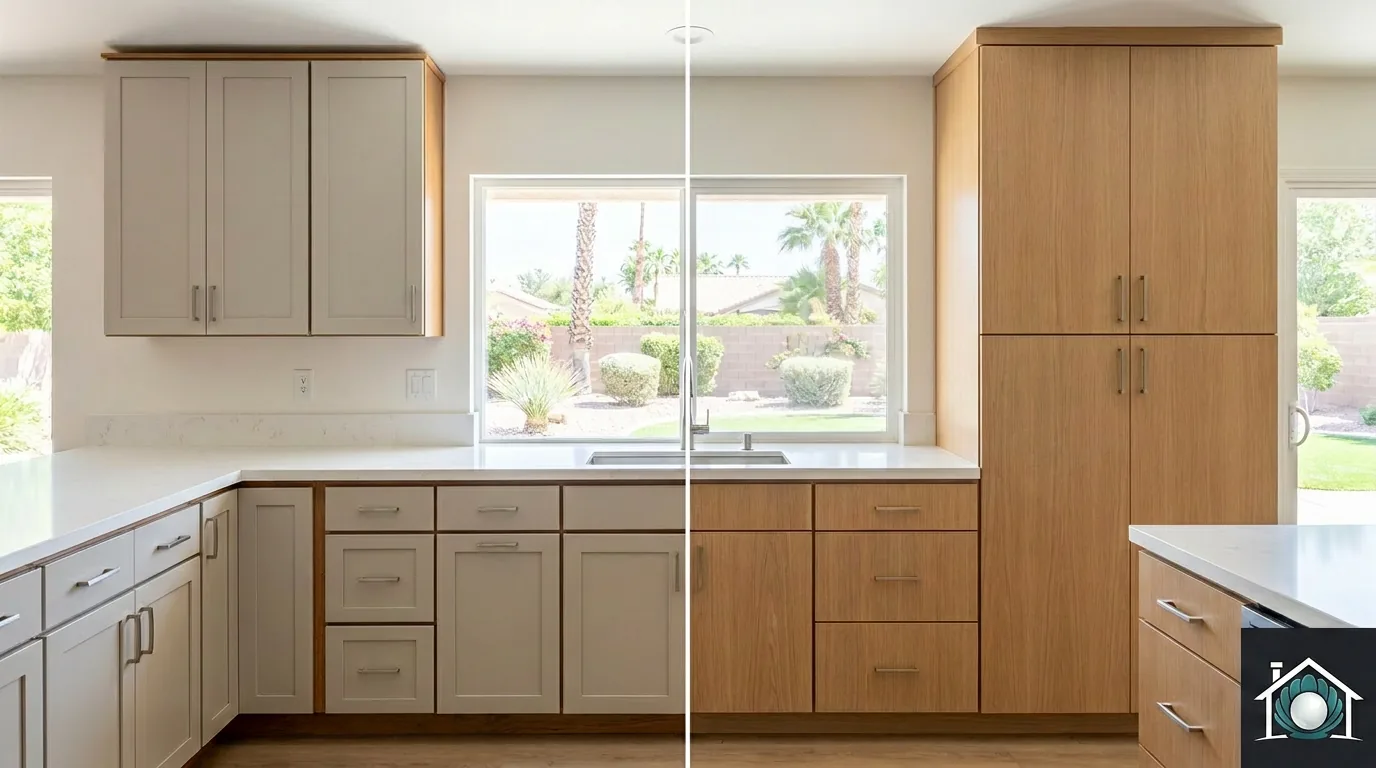
Cabinet refacing keeps the existing cabinet boxes - the structural sides, tops, bottoms, and shelves that attach to the wall and floor - and replaces everything visible from the outside. New cabinet doors, new drawer fronts, new end panels, and a thin veneer applied to any visible parts of the cabinet boxes (the face frames and exposed sides). New hinges, new drawer slides, and new hardware typically install at the same time, and many refacing projects also add features like soft-close mechanisms and pull-out shelving in the lower cabinets.
The visible result is a kitchen that looks like new cabinets. The hidden reality is that the original cabinet boxes - the unseen structure inside the wall - remain in place.
Refacing requires that the existing cabinets meet certain conditions. The boxes need to be structurally sound (no water damage, no significant warping, no rotted material). The face frames need to be in good enough shape to accept new veneer cleanly. The layout needs to work for the homeowner because refacing does not move cabinets or change configuration.
What Full Replacement Actually Is
Cabinet replacement removes the existing cabinets entirely and installs new cabinets in their place. The new cabinets can match the existing layout exactly, modify it slightly, or completely reconfigure the kitchen footprint with new placement of base cabinets, upper cabinets, and specialty units.
Replacement opens up choices that refacing cannot. Layout changes (moving the sink, adding an island, reconfiguring the pantry). Different cabinet heights (replacing standard 30-inch upper cabinets with taller 36- or 42-inch units that reach the ceiling). Different specialty units (lazy susan corners, appliance garages, pull-out trash and recycling). Different construction quality (replacing builder-grade particleboard with quality plywood-box construction).
The trade-off is significantly higher cost, longer project timeline, and more disruption to the rest of the home during construction. The kitchen is non-functional for the duration of cabinet replacement; in refacing the kitchen remains largely usable throughout.
Side-by-Side Comparison
| Attribute | Refacing | Full Replacement |
|---|---|---|
| Typical cost (standard kitchen) | [$8,000 - $25,000] | [$18,000 - $60,000+] |
| Active construction time | 3 - 7 days | 2 - 4 weeks |
| Kitchen usable during work | Mostly yes | No |
| Material lead time | 4 - 8 weeks (custom doors) | 6 - 12 weeks (semi-custom cabinets) |
| Layout changes possible | No | Yes |
| Cabinet height changes possible | Limited | Yes |
| Box construction upgrade possible | No | Yes |
| Door style range | Wide - any current door style | Wide - any current door style |
| Storage upgrades possible | Yes (interior accessories) | Yes (interior + new specialty cabinets) |
| Disruption to rest of home | Modest | Significant |
| Resale value impact | Modest positive | Stronger positive |
| Lifespan of finished result | 15 - 20 years | 25 - 35 years |
Refacing wins on cost, speed, and minimal disruption. Replacement wins on design flexibility, construction quality, and longevity. The kitchen’s specific condition and the homeowner’s goals usually point clearly to one or the other.
When Refacing Is the Right Choice
Refacing is the right choice for several specific scenarios.
The kitchen layout works as it is. The sink is where the homeowner wants it. The range location is correct. The pantry is in a useful spot. No island is missing. The work triangle is functional. If the layout requires changes - moving fixtures, adding an island, reconfiguring storage zones - refacing cannot accommodate them.
The existing cabinets are structurally sound. Solid plywood boxes or even quality particleboard boxes in good condition can carry new doors and veneer reliably. Cabinets with water damage, sagging shelves, broken hardware, or delaminated boxes are not good candidates.
The budget is constrained but the existing kitchen needs visual refresh. Refacing typically costs 35 to 60 percent of comparable replacement at the same finish quality. For homeowners with moderate budget who want a fresh-looking kitchen, refacing delivers most of the visual benefit at a fraction of the cost.
The kitchen needs to remain usable during the project. Refacing keeps countertops, sink, and appliances in place. The kitchen is functional through the entire project except for brief windows when individual doors come off and go back on. For households that cannot vacate the kitchen for weeks, this matters significantly.
The timeline is tight. Refacing typically wraps in days rather than weeks. For homeowners with a target date approaching (entertaining, family visit, end of summer), refacing can deliver where full replacement cannot.
The cabinets are part of a recently completed broader remodel. A homeowner who remodeled the kitchen 10 years ago and now wants a refresh without redoing the whole project is a perfect refacing candidate.
When Full Replacement Is the Right Choice
Replacement is the right choice in the opposite scenarios.
The kitchen layout needs to change. Any move of plumbing fixtures, addition of an island, reconfiguration of the work zones, or significant change in cabinet placement requires removing the existing cabinets. Refacing does not solve layout problems.
The existing cabinets have structural problems. Water damage from a slow leak under the sink. Particleboard boxes that have expanded from moisture. Broken or sagging shelves. Cabinets that were originally low-quality builder-grade that have not aged well. Trying to reface compromised boxes produces a kitchen with new doors on tired structure - the new doors usually outlast the boxes.
The homeowner wants modern cabinet features that the existing cabinets cannot support. Taller upper cabinets reaching the ceiling. Different cabinet depths. Quality pull-out interiors. Specialty corner cabinets. Soft-close everywhere. Some of these can be retrofitted into refacing projects; many cannot.
The whole kitchen is being remodeled anyway. If countertops, backsplash, flooring, appliances, and layout are all changing, the cabinets typically also need to change. Trying to preserve the existing cabinets in a comprehensive remodel often creates compromises that show in the final result.
The homeowner plans to stay in the home for many years and wants the longest lifespan from the investment. Quality replacement cabinets typically last 25 to 35 years before needing significant attention; refaced cabinets typically last 15 to 20 years before the refresh starts to show its age.
What Refacing Does Not Fix
A few important things that refacing cannot address even when the project goes well:
Refacing does not change the cabinet layout. If the sink position is awkward, if the pantry is too small, if the work triangle is poor, refacing leaves all of those issues in place.
Refacing does not upgrade the box construction. Particleboard cabinets remain particleboard cabinets after refacing. The hidden structure underneath is unchanged.
Refacing does not change the cabinet depths or heights significantly. Standard 12-inch deep upper cabinets remain 12 inches deep. Cabinets that end at the top of a 30-inch upper run still leave the same gap to the ceiling.
Refacing does not address moisture damage, hidden mold, or pest issues that may exist behind or inside the cabinets. These need to be remediated before refacing makes sense.
Refacing does not modernize the cabinet interiors unless interior upgrades are specifically added to the project. Drawer interiors, shelf configurations, and corner unit access remain whatever they were originally unless the project includes interior upgrades.
The Middle Ground - Refacing Plus
Many real-world refacing projects extend beyond pure refacing to address specific limitations. Common additions:
Replacing the worst-condition cabinet boxes (perhaps the under-sink cabinet that has water damage) while refacing the rest. The new cabinet matches the refaced cabinet style.
Adding a new cabinet or two to expand storage (a tall pantry next to the refrigerator, an island, an appliance garage on the counter) while refacing the existing cabinets.
Replacing the cabinets in one zone of the kitchen (the main run) while refacing in another zone (the secondary wall or peninsula).
Pairing refacing with new quartz or porcelain countertops, a new backsplash, and updated lighting and fixtures. The cabinets are refaced but the rest of the kitchen is refreshed, creating a substantial visual transformation.
These hybrid approaches let homeowners customize the project to their specific kitchen and budget rather than choosing between pure refacing and full replacement.
Cost in Green Valley
Refacing pricing in Green Valley typically falls in these ranges:
- Basic refacing (mid-tier door style, standard hardware): [$8,000 - $15,000] for a standard 10x10 to 12x12 foot kitchen
- Premium refacing (custom door style, premium hardware, soft-close mechanisms, pull-out interior accessories): [$15,000 - $25,000]
- Refacing with additional features (new island, new appliance garage, replacement of some cabinets): [$15,000 - $35,000]
Replacement pricing for kitchen remodels in Green Valley typically runs:
- Mid-tier replacement (semi-custom cabinets, standard installation): [$18,000 - $35,000]
- Premium replacement (custom cabinets, premium hardware, full interior packages): [$35,000 - $80,000+]
- Full layout change with replacement (new island, relocated sink, structural work): [$45,000 - $120,000+]
These ranges are general industry pricing for the Green Valley market and depend on cabinet tier, scope, and complexity.
Timeline Reality
Refacing project timeline typically runs 6 to 12 weeks total - 1 to 2 weeks for design and door style selection, 4 to 8 weeks for custom door fabrication, and 3 to 7 days of active installation. The kitchen remains largely usable throughout the project except for brief windows when doors are being installed.
Replacement project timeline typically runs 12 to 20 weeks total - 2 to 4 weeks for design and cabinet selection, 6 to 12 weeks for cabinet manufacturing and delivery, and 2 to 4 weeks of active construction. The kitchen is non-functional for most of the active construction phase.
If you are weighing refacing vs replacement for your Green Valley kitchen, Pearl handles both approaches as well as the hybrid middle-ground projects across the valley. Request a free in-home consultation or call (702) 602-8385. We will look at the existing cabinet condition, talk through what you want the result to feel like, weigh the trade-offs honestly, and put together a realistic plan and quote for the approach that fits.