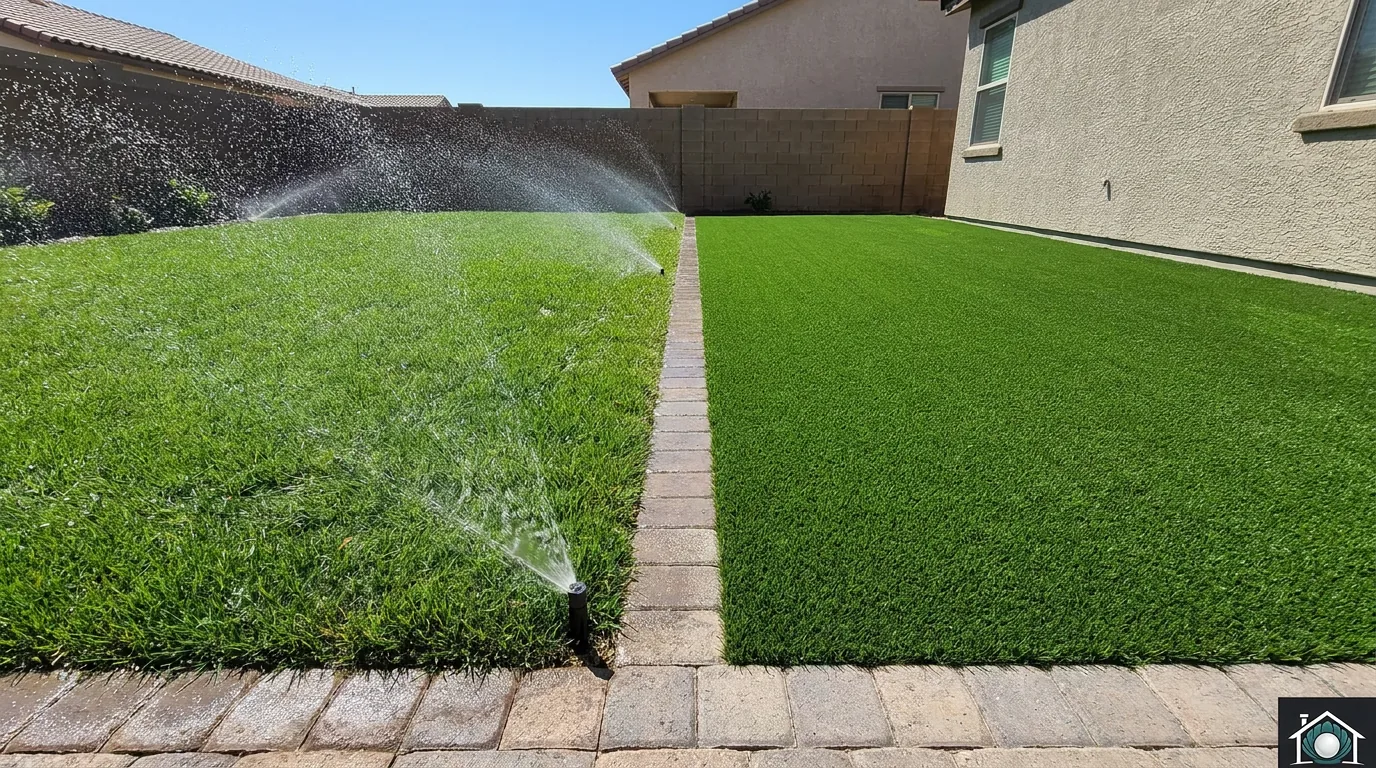
Real grass loses its appeal in Paradise NV around the second week of June. By then the heat is consistent enough that lawns either go dormant, go brown, or demand a small fortune in water and care to keep looking presentable. By August even well-tended Bermuda is showing stress, the dog has worn paths through the weak spots, and the water bill has tripled.
Artificial turf is now the default choice across Paradise and the rest of the valley for good reason. But it is not a free lunch. Turf has trade-offs - real ones - and the wrong product or a careless install ends up looking worse than the grass it replaced. Here is an honest comparison of artificial turf vs real grass in Paradise summers, and what to consider before committing.
Why Real Grass Struggles in Paradise NV
Three things make Paradise hard on real grass:
- Sustained extreme heat. Daytime highs from mid-June through early September regularly clear 105 degrees, and Bermuda grass - the only real option for this climate - needs near-daily water during that window to stay green.
- Water cost and restrictions. SNWA (Southern Nevada Water Authority) has progressively tightened residential watering rules. Many Paradise neighborhoods are restricted to specific watering days and times, and decorative grass removal rebates have reshaped what people put in front of and behind their homes.
- High evapotranspiration. Even with watering, the dry air pulls moisture out of the soil and out of the grass leaves at a high rate. Lawns that look fine on Wednesday can look stressed on Friday.
Bermuda grass survives this climate, just barely. Fescue, ryegrass, Kentucky bluegrass, and other cool-season species do not. Anyone selling you a “summer-tolerant fescue blend” for a Paradise lawn is selling a lawn that will fail.
Why Artificial Turf Took Over the Valley
Turf solves the water problem, the maintenance problem, and the heat-survival problem in one installation. The valley-wide adoption rate has been driven by:
- Effectively zero water use for the lawn itself (occasional rinsing for cooling and cleaning).
- No mowing, fertilizing, edging, weed control, or seasonal renovation.
- A consistent green appearance year-round, even when nothing else is growing.
- SNWA rebates for converting grass to turf or desert landscape - check current rebate amounts on the SNWA website before starting.
- HOA acceptance in most Paradise communities. Where turf was once contested, most architectural standards now explicitly allow it.
The downside is that turf has its own real costs and limitations - and they are different from grass costs and limitations, not absent.
Side-by-Side Comparison
| Attribute | Real Grass (Bermuda) | Artificial Turf (Premium) |
|---|---|---|
| Installed cost (1,000 sq ft) | [$2,500 - $5,000] sod install + landscape prep | [$10,000 - $20,000] full install with sub-base |
| Annual water cost | [$600 - $1,800] (varies with rates and irrigation efficiency) | Negligible (occasional rinsing) |
| Annual maintenance | Mowing every 5 to 7 days in growing season, fertilizing 4 to 6 times, edging, weed control, overseeding | Brushing 2 to 4 times a year, occasional rinse, infill top-up every 5 to 8 years |
| Lifespan | Indefinite if maintained; periodic replacement of damaged sections | 12 to 20 years on premium turf; 5 to 8 years on bargain turf |
| Surface temp on a 105 degree day | Roughly 95 to 105 degrees | Roughly 140 to 170 degrees on standard turf; 115 to 140 degrees on cool-touch turf |
| Pet friendliness | Easy on paws, urine kills patches | No paw burn issues at cooler hours; urine drains through, but odor builds up without rinsing |
| Kid friendliness | Soft underfoot, naturally cool, can stain clothes | Soft underfoot, hot in summer afternoons, no stains |
| Water restrictions | Subject to SNWA watering schedule | Unaffected |
| Resale impact | Positive if well-maintained, negative if brown/patchy | Generally neutral to positive in current market |
| Drainage in a monsoon downpour | Absorbs and slowly drains | Drains through immediately if sub-base is correct |
| Allergens (pollen) | Produces pollen during growing season | None |
| Carbon and ecology | Living plant, supports soil biology | Plastic product, no soil benefit |
The numbers tell most of the story. Real grass is dramatically cheaper to install but much more expensive to maintain over the long run. Turf has the high installation cost and roughly half the lifespan of a well-tended lawn, but the operating cost is near zero.
For a 1,000-square-foot lawn over 15 years, total cost of ownership often lands closer than the installation prices suggest - real grass at roughly [$15,000 - $30,000+] all-in over 15 years (sod, water, maintenance, repairs), turf at roughly [$10,000 - $22,000+] over 15 years (install, occasional rinsing, infill top-up, eventual replacement). The real cost gap is small. The lifestyle gap is large.
The Surface Temperature Question
The single biggest weakness of artificial turf in Paradise is summer surface temperature. On a clear July day with the air temperature at 108 degrees:
- Real Bermuda grass: 95 to 105 degrees on the surface. Tolerable for bare feet and pets.
- Standard dark-green nylon turf: 140 to 170 degrees. Hot enough to burn skin and dog paws within seconds.
- Cool-touch / lightened turf with reflective infill: 115 to 140 degrees. Uncomfortable but not immediately damaging.
This is not a small difference. It changes how the backyard is used:
- Mid-day in July and August: turf is functionally unusable for kids and pets without a hose-down first. A 5-minute soak drops the surface temperature 30 to 50 degrees for about an hour.
- Morning and evening: turf is fine. Most family use of a backyard happens before 11 AM or after 5 PM in summer anyway.
- Year-round in shade: turf in shade stays close to ambient temperature. Designing the yard with shade structures over the high-use areas of the turf solves the heat issue almost entirely.
If kids or dogs use the yard heavily during peak afternoon hours all summer, real Bermuda may serve them better despite the maintenance burden. If the yard is mainly used for entertaining, lounging, and morning / evening play, turf with strategic shade is the more practical choice.
Pets and Kids - Honest Trade-offs
Pets: Most dogs adapt to turf quickly. The drainage means urine flushes through and does not kill patches the way it does on real grass. The downside is that residue builds up over time and can produce a noticeable odor on hot days. Regular rinsing (a couple of minutes with the hose, twice a week) prevents the buildup. For solid waste, turf is just as easy to pick up as grass. Premium pet-rated turf has antimicrobial backing that helps.
Kids: Turf is great for play during cool hours, problematic during hot hours. Carpet-style burn from sliding falls is a real risk on cheap short-pile turf - check the product specs and choose a longer-pile fiber if kids are sliding around. For toddlers, a small natural-grass play patch surrounded by turf is sometimes the right hybrid.
Drainage and Sub-Base Matter More Than the Turf
The single biggest predictor of how a turf install will look in 5 years is the sub-base, not the turf itself. Cheap installs skimp here, then the turf shifts, develops low spots, and starts to look uneven.
Done correctly, the sub-base is a 3- to 4-inch layer of crushed aggregate, compacted to a firm grade with proper slope for drainage, with a permeable weed barrier between the soil and the aggregate. The turf is then stretched over the prepared base, seamed properly, and infilled with sand or specialty cooling infill brushed in.
Done incorrectly, the install puts turf directly over loosened soil or thin gravel, with poor drainage, and seams that come apart within a year. This is where the [$5 per square foot] online quote ends. The difference is in the labor and material under the turf, not the turf itself.
Resale Value Impact in Paradise
The local market has shifted in turf’s favor. In a recent sales context across Paradise and nearby zip codes:
- A well-installed premium turf yard reads as a thoughtful upgrade. Many buyers ask whether the yard is turf during showings, hoping the answer is yes.
- A neglected real-grass yard - patchy, brown, or with worn paths - is a noticeable strike.
- A pristine real-grass yard is still attractive but less common as a selling feature than it was a decade ago.
- Cheap, obvious-looking turf with visible seams, pile flattening, or color shift hurts resale and gets flagged by inspectors.
Quality matters more than the choice between grass and turf. A poorly maintained example of either reads as deferred maintenance.
HOA and SNWA Considerations
Most Paradise master-planned communities now allow turf in front and back yards, but the architectural standards usually specify:
- Approved pile heights (typically 1.5 to 2 inches)
- Approved color tones (no neon greens)
- Edging requirements (paver, stone, or metal between turf and hardscape)
- Sometimes a maximum percentage of the front yard that can be turf vs desert landscape
Check the architectural standards or have your contractor pull the requirements before quoting. The SNWA also offers cash rebates for converting decorative grass to turf or desert landscape - rebate amounts and qualifying criteria change periodically, so confirm current eligibility before banking on the rebate in your project budget.
A Hybrid Approach Often Wins
The all-or-nothing framing misses what works for many Paradise yards. A common hybrid:
- Turf for the main usable lawn area, sized for the actual play and lounging footprint.
- Desert landscape (decorative gravel, drought-tolerant plants) for the unused perimeter, eligible for SNWA rebates.
- Paver patio or hardscape for the seating and entertaining zone, shaded by a covered structure.
- Optional small natural grass patch if a child or dog needs it - manageable in size.
This split reduces water use dramatically, qualifies for partial rebates, gives kids and pets something cool underfoot for true mid-day play, and avoids the drawbacks of either extreme.
Planning the Project
A turf install for a typical Paradise backyard takes 3 to 7 days of active work, plus 1 to 2 weeks for design and material ordering on the front end. A full backyard remodel that includes turf, hardscape, irrigation rework, and a covered patio runs 4 to 8 weeks of active construction.
The best windows for turf installation in Paradise are March through May and September through November - cooler weather for the crew and gentler conditions for the materials during install. June through August installs are common but the crew works early-morning shifts and progress slows.
Pearl handles full backyard remodels including outdoor living projects across Paradise and the rest of the valley. If you are weighing turf vs grass for your specific yard, request a free in-home consultation or call (702) 602-8385. We will look at sun exposure, drainage, intended use, and any HOA constraints, and put together a realistic plan and quote.